Colmeal

Community-Led, Inclusive, Data-Driven Development.

A principles-driven approach, co-created by Salanga, that systematically positions communities to define, measure, and lead their own development journey.

living within 9 countries and 120+ communities in partnership with organizations funded by Global Affairs Canada, USAID, Czech Development Cooperation and others.

An Opportunity for Transformative Change

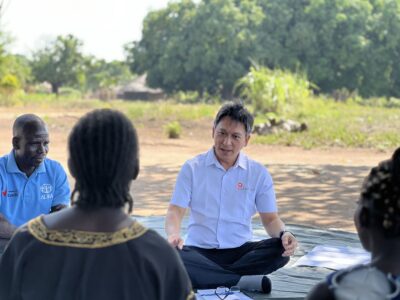
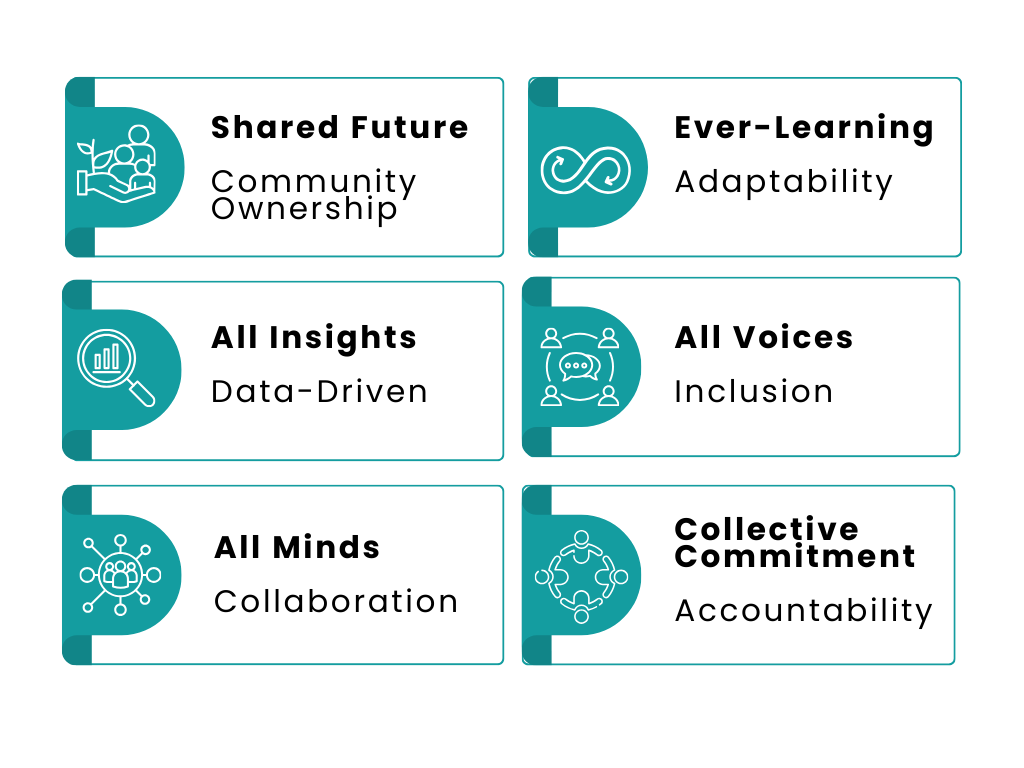
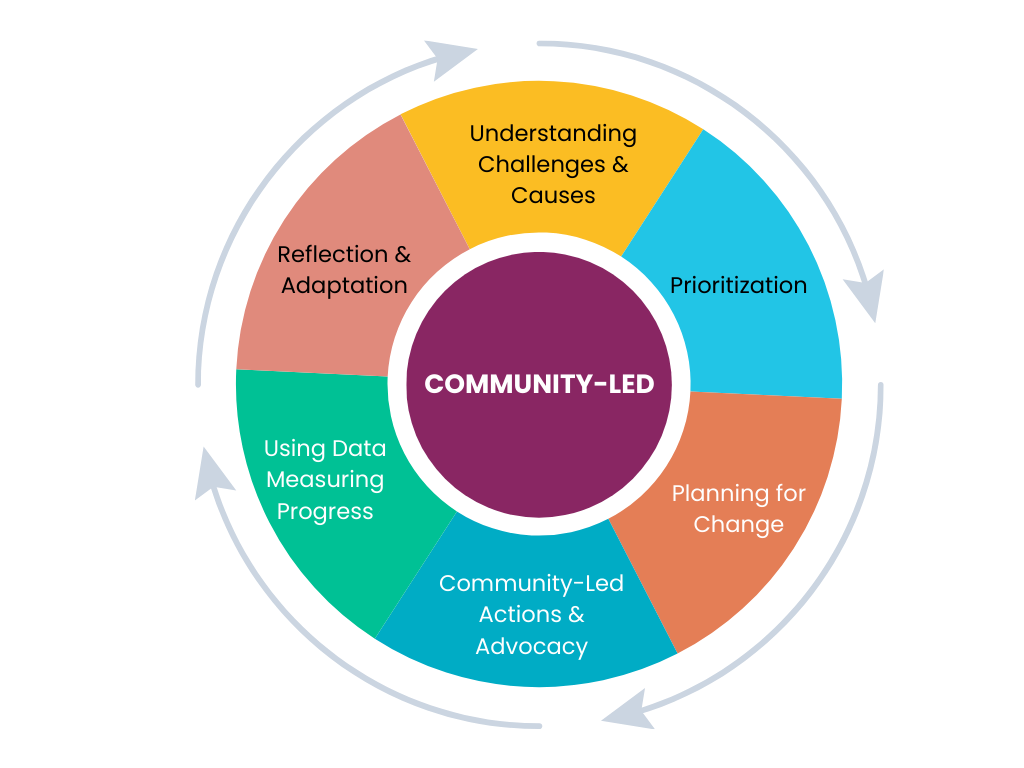
Colmeal offers a structured yet flexible framework that enables communities in all their diverse forms—from a village, a government entity at the sub-district level, to a community of health practitioners or GBV responders —to make all voices count (especially marginalized voices), collectively assess their reality, establish their own markers of success, and use data that they generated to learn, adapt, and drive action plans towards sustainable change. Guided by six core principles, Colmeal places assessment, planning, monitoring, and learning directly in the hands of communities — strengthening ownership, accountability, and resilience in complex environments.

Colmeal Facilitates 3 Systemic Changes:

1. Accountability that flows downward and inward.

Communities strengthen accountability to their own aspirations and collectively defined indicators of success, while institutions become more responsive and transparent.

2. Adaptive capacity in complex contexts.

By embedding iterative reflection and adaptation cycles at community level, Colmeal enables continuous course correction — strengthening resilience in volatile environments.

3. Lasting ownership beyond project cycles.

When communities own the agenda and the evidence, motivation and collective action persist after external funding ends, increasing the likelihood of sustained outcomes.

A snapshot from a growing evidence base

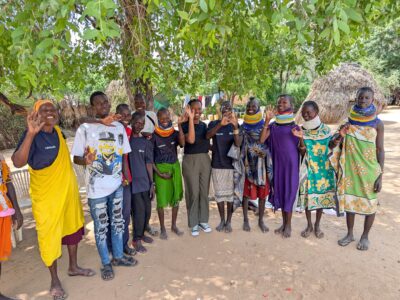
Across programmes in Kenya, Uganda, the Philippines, and Cambodia, communities using Colmeal are generating their own evidence of change — and acting on it.

In Kenya, negative impacts reported by community members dropped from 60% to 11% within one year, as communities identified root causes and led their own responses. Community elders participated in sub-county budget discussions for the first time — processes they had not previously known they could join.
In Uganda, two parishes allocated their own budgets to bring Colmeal to their communities — without external funding or direction.

In Kenya, a government probation office independently adapted Colmeal for rehabilitation work after observing it in community settings. Staff began training colleagues in other locations using their own resources. The approach spread because it worked.

These are sampled findings from an evolving evidence base. Salanga maintains the Living Evidence Register, tracking outcomes, confidence levels, and gaps with the same rigour we ask of others.

Evidence from the TOGETHER and STRONGER programmes, funded by Global Affairs Canada.

Principles

Process

Colmeal with ADRA Canada

ADRA Canada and its implementing partners, funded by Global Affairs Canada are among the early adopters of the Colmeal Approach. This case study highlights some of the early results and lessons learned.

Colmeal Overview Leaflet

Download our Colmeal leaflet. Learn about Colmeal, the process, emerging outcomes and a snapshot of a fascinating case study from Kenya

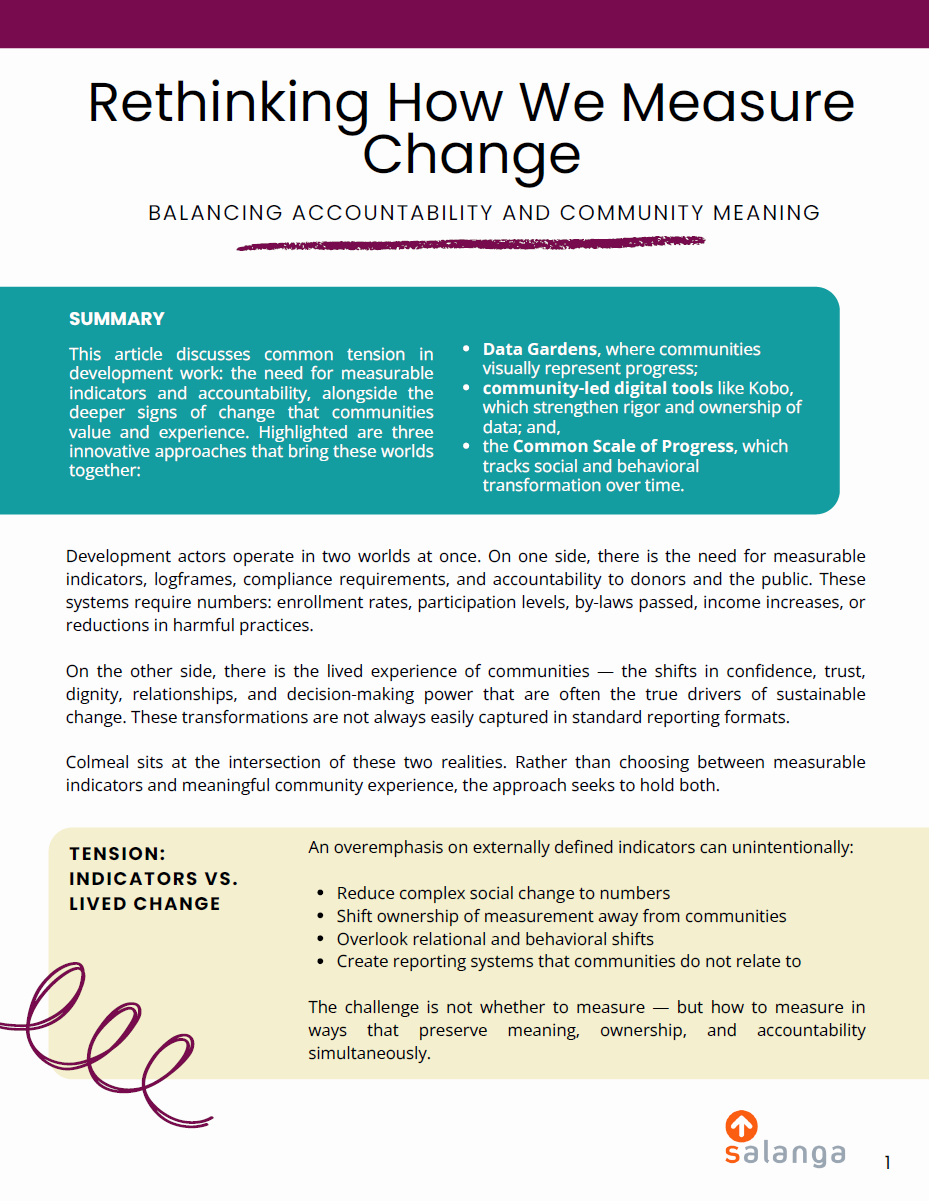
Rethinking How We Measure Change

Learn about three Colmeal-inspired innovative approaches that connect the deeper signs of change for communities and shared accountability

How is Colmeal different from participatory development approaches?

Most participatory approaches invite communities into a project’s process.

In Colmeal communities lead their own governance, change and learning processes, while Colmeal helps them to better integrate into what partners already do.

Evidence ownership. Communities generate, interpret, and use their own data — not as a reporting requirement, but as an asset for their own decision-making and advocacy.

Inclusion as accuracy. Marginalised voices — women, youth, those furthest from power — are included because they hold insights no other actor can generate. In the Philippines, youth identified the normalisation of violence that adult officials had not recognised.

Accountability on community terms. Communities decide which institutions to engage — not the other way around. This shifts engagement from consultation to accountability.

Working within existing systems. Colmeal integrates into existing structures rather than creating parallel ones. In the Philippines, it was embedded into government planning cycles. In Sri Lanka, it integrated into an existing programme framework.

Self-propagating adoption. When the approach fits, it spreads without project resources. In Kenya, a government institution independently adapted Colmeal and began training staff across multiple locations. In Uganda, parishes self-funded adoption.

Built-in quality safeguards. Organic spread does not mean unmanaged spread. Colmeal includes structured reflection processes and a growing network of Colmeal Hubs — organisations and government bodies supporting adoption in their contexts.

How does Colmeal complement Feminist monitoring and evaluation?

Colmeal and Feminist M&E are complementary approaches that prioritize the perspectives and experiences of community members facing social, economic, and political exclusion. Colmeal involves community members taking ownership over monitoring and evaluation, while Feminist M&E takes a gender-transformative approach to M&E that seeks to address gender inequalities and power imbalances. 

Together, these approaches can help ensure that development initiatives are responsive to the needs and priorities of community members whose voices are commonly not heard, including women and girls. By combining these approaches, development initiatives can be more effective, equitable, and sustainable.

Salanga’s Role

Salanga is a thought-leader and innovating practitioner of Colmeal as part of the global movement of community-led programming.

Community-ownership is a core principle of Salanga’s practice and work with its partners. We support development organizations in the practical implementation of MEAL systems and enhancing their capacity in MEAL through partnerships in project implementation, training, consultancy and technology.

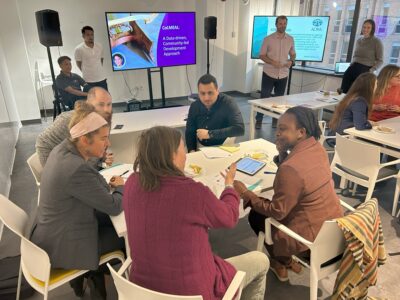
To support organizations in adopting the Colmeal approach, Salanga partners with organizations to:

  1. Assess organizational readiness to implement Colmeal
  2. Develop joint proposals for/advise on Colmeal integration into project design – including consideration for structure, systems, and accountability
  3. Update/develop policies and guidance on their Colmeal process
  4. Adapt the Colmeal capacity building framework to their organizational approach and project contexts
  5. Provide capacity building for project staff to implement Colmeal
  6. Facilitate reflective processes to ground and mainstream Colmeal into their organization

Contact us at info@salanga.org for more information about support and partnerships related to Colmeal.

Watch our webinars “What is Colmeal?” and “Is your organization ready for Colmeal?” and be sure to scroll to the bottom of the page to sign up for our Colmeal newsletter so you never miss any updates.

Testimonials

Watch our webinars “What is Colmeal?” and “Is your organization ready for Colmeal?”

Scroll to the bottom of the page to sign up for our Colmeal newsletter so you never miss any updates.

Webinar 1: What Is Colmeal?

Webinar 2: Is your organization ready for Colmeal?

Colmeal News

Strengthening Feedback Loops and Data Flow

Strengthening Feedback Loops and Data Flow When we talk about strengthening feedback loops in MEAL systems, we’re not simply talking about better reporting processes. We’re talking about restructuring how knowledge moves — and ultimately, who holds power in decision-making. If...
Read More

Come and See: Community-Led Evidence of Impact

When localization is discussed in operational spaces, the same concerns and questions surface repeatedly as constraints that shape decisions and implementation: These questions are not unfounded. They reflect real responsibilities related to accountability, stewardship of resources, fiduciary risk, evidence quality,...
Read More

Event Summary: Pathways to Localization

Community-Led Monitoring, Evaluation, Accountability and Learning (Colmeal) is an approach to MEAL that capacitates diverse key community members/change agents, including the marginalized and vulnerable, to continually monitor, analyze, share, and reflect on progress against their community development plans based on outcomes and indicators/metrics they define to take action to achieve their goals/vision.

Q&A Adapting Colmeal to Context

Community-Led Monitoring, Evaluation, Accountability and Learning (Colmeal) is an approach to MEAL that capacitates diverse key community members/change agents, including the marginalized and vulnerable, to continually monitor, analyze, share, and reflect on progress against their community development plans based on outcomes and indicators/metrics they define to take action to achieve their goals/vision.

You are donating to : Greennature Foundation

How much would you like to donate?
$10 $20 $30
Would you like to make regular donations? I would like to make donation(s)
How many times would you like this to recur? (including this payment) *
Name *
Last Name *
Email *
Phone
Address
Additional Note
paypalstripe
Loading...
Privacy Overview

This website uses cookies so that we can provide you with the best user experience possible. Cookie information is stored in your browser and performs functions such as recognising you when you return to our website and helping our team to understand which sections of the website you find most interesting and useful.