Beyond Participation: My journey with Colmeal training in Turkana West, Kenya
By Sandrine Umuhoza, Learning and Impact Associate
Sometimes the most powerful lessons don’t come from books or reports. They come from being present, listening, and experiencing things firsthand. That’s exactly what happened to me during a recent Colmeal training in Kenya. What began as a work assignment of learning quickly turned into a journey that changed how I see communities, data, and even the meaning of success.
I work on Colmeal evidence and storytelling at Salanga, helping make community knowledge legible to decision-makers without flattening it. Most of my work is about turning evidence into something teams can use shaping better decisions, stronger learning, and real accountability. That’s why this training mattered: it wasn’t just about learning a methodology, it was about stepping into what evidence looks like when communities lead the process
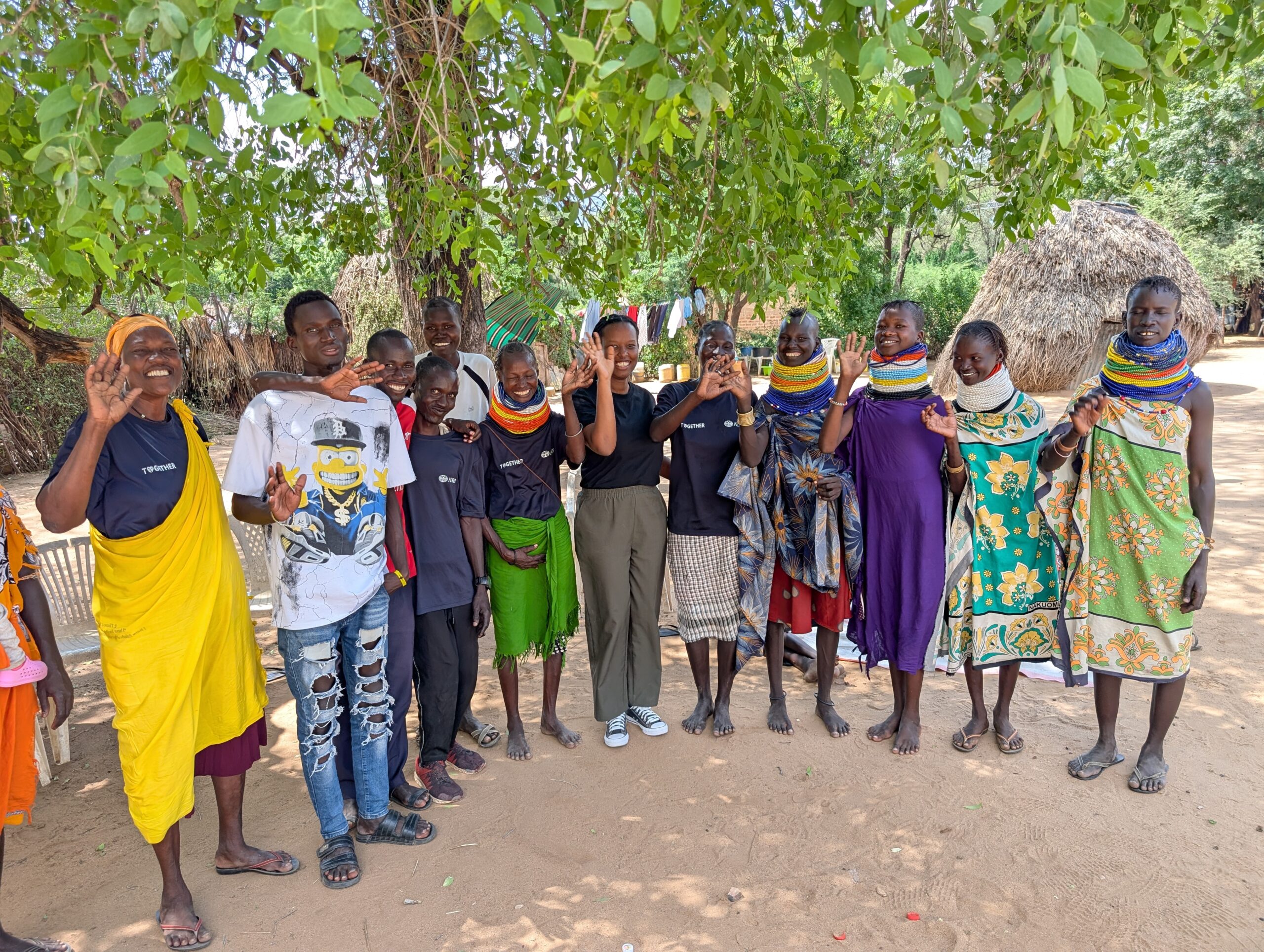
On August 29th, 2025, I traveled from Rwanda to Kenya to participate in a Colmeal Training. This activity was part of the launch of a new project titled STRONGER, led by ADRA Canada and in partnership with ADRA Kenya, Salanga and others, which aims to enhance the equal enjoyment of rights by adolescent girls and women (AGW) to live free from gender-based violence (GBV), including child, early, and forced marriage. Through a multi-sectoral, community-led, and gender-transformative approach, the STRONGER project seeks to strengthen the quality and governance of GBV-responsive health systems, build AGW’s agency in rights protection, and challenge harmful gender norms and practices that perpetuate violence and inequality.
The project integrates Colmeal as a key component of its community-led development approach, ensuring that communities actively define, monitor, and drive their own change processes.
The training took me to Kakuma, in northern Kenya, where STRONGER will be implemented. I was excited not just for the training, but also because I was finally going to meet my colleagues in person. Until then, we had only seen each other online. Meeting Jakub Nemec (Executive Director), Alex Navye (Colmeal Advisor), and Joseph Aaron Urlanda (MEAL Advisor) face-to-face for the first time felt special.
We kicked things off with reflection sessions and conversations about what Colmeal means to us. For me, this was different. Before now, I had only read about Colmeal. I had never experienced it before. That made me curious: how would the theory I had in my head translate into something alive and practical?
The Principles That Stuck with Me
The more I listened, the more I realized Colmeal isn’t just a method, it’s a mindset. It’s built on a few simple but powerful principles:
- Shared Future: Asking where we want to be and deciding that together.
- All Minds: Everyone has a part to play, not just the “experts.”
- All Voices: Every person’s perspective matters, no matter their age, gender, or background.
- All Insights: Data belongs to the community, not outsiders.
- Adaptability: Nothing is rigid. It has to fit the community’s context.
- Collective Commitment: Accountability comes from within the community, not from the top down.
Reading about these principles was one thing. Experiencing them, even in a training room, was something else entirely.
Through this firsthand experience, I came to see that Colmeal was not about delivering answers to communities; it is about co-creating with them. It transforms the role of communities from being recipients of change to being the drivers of change and owners of their future. With the right tools and space, people can shape their own lives in ways that make sense for them. That realization was inspiring. And it wasn’t just me who felt this, the joy in the room was contagious. Every participant brought energy and hunger to learn, as if we all knew we were touching something truly meaningful.
Walking Through the Training Journey
The training took us through the whole Colmeal process and cycle- from identifying the right community, to preparing for an entry meeting, to identification and prioritizing challenges, planning solutions, and eventually celebrating success.
What I love is that Colmeal doesn’t shy away from hard questions. At every step, we were asked: What will be different? How will we know? It reminded me that real accountability is not in a report; it’s in the lives of people who feel the change.
We also kept coming back to something simple but profound: communities already hold knowledge and practices. Colmeal doesn’t replace those; it builds on them. That gave me a lot to think about.
What the Simulations Taught Me
The simulations and role play were the part of the training that really opened my eyes. We created a “typical” community, elected a Community Management Committee (CMC), and acted out how decisions might be made.
In one simulation, I played the chief of a village called Nanam. The ADRA team came to introduce Colmeal, and I made it tough for them. I was a skeptical, even harsh, chief. It was a bit funny afterward, but it taught me how crucial first impressions are and how important it is to listen deeply when entering a community.
In another, I played a 14-year-old girl being forced into marriage with an older man. That one hit me hard. Even though it was just a role play, it made me think about countless girls who don’t get to choose their futures. I kept wondering: could Colmeal create a space where voices like theirs are heard? Where can girls actually decide for themselves? That question has stayed with me.
Data, Ownership, and What Success Really Means
Another lesson I carried away was about data. I’ve always thought of data as numbers on a page. But Colmeal reframed from it for me. What if data is also the change a community notices? The progress they celebrate?
That led me to a deeper question: do we ever stop to ask communities what success looks like to them? Their idea of success might be different from what we planned, but maybe that’s the point. Real ownership means letting the community define progress for themselves and when they do, checking progress becomes so much easier, because it belongs to them.
Closing Reflections
Looking back, the training in Kakuma was more than just a work assignment, it was a journey of unlearning and relearning. I came in with the theory of Colmeal in my head. I left with a lived sense of how it feels when communities truly lead.
The principles — shared future, all minds, all voices, all insights, adaptability, and collective commitment – are no longer just words to me. I saw them come alive through exercises, simulations, and conversations. I understood how fragile, yet powerful this process can be.
The biggest shift for me was in how I think about data and ownership. Numbers matter, but stories and lived experiences matter just as much. Success isn’t for us to define it’s for communities to decide. That realization felt revolutionary, because it puts power back where it belongs: with the people.
And what made the whole experience even more meaningful was the atmosphere in the training itself. The joy, laughter, and the constant eagerness to learn showed me that Colmeal isn’t just about methodology, it’s about energy and spirit. When people feel ownership, they come alive. When they see themselves as drivers of change, learning is no longer an obligation. It’s a joy.
As I left Kakuma, I didn’t just carry new skills. I asked new questions. I was left inspired by the idea that Colmeal isn’t a recipe, but a journey of listening, learning, and adapting together. It’s about opening space for voices that are too often left out and trusting communities to define their own tomorrow. And for me, that is not only powerful, but also hopeful!
Thanks to Sandrine Umuhoza, Salanga’s Learning and Impact Associate for sharing her reflections on Colmeal training!
Read more articles:
- Strengthening Feedback Loops and Data Flow
- Beyond Participation: My journey with Colmeal training in Turkana West, Kenya
- Come and See: Community-Led Evidence of Impact
- How to Capture Fast, High Quality Lessons Learned in Remote Teams: Practical Tips Any Organization Can Use
- From Reporting to Learning: Making the Case for Mutual Accountability